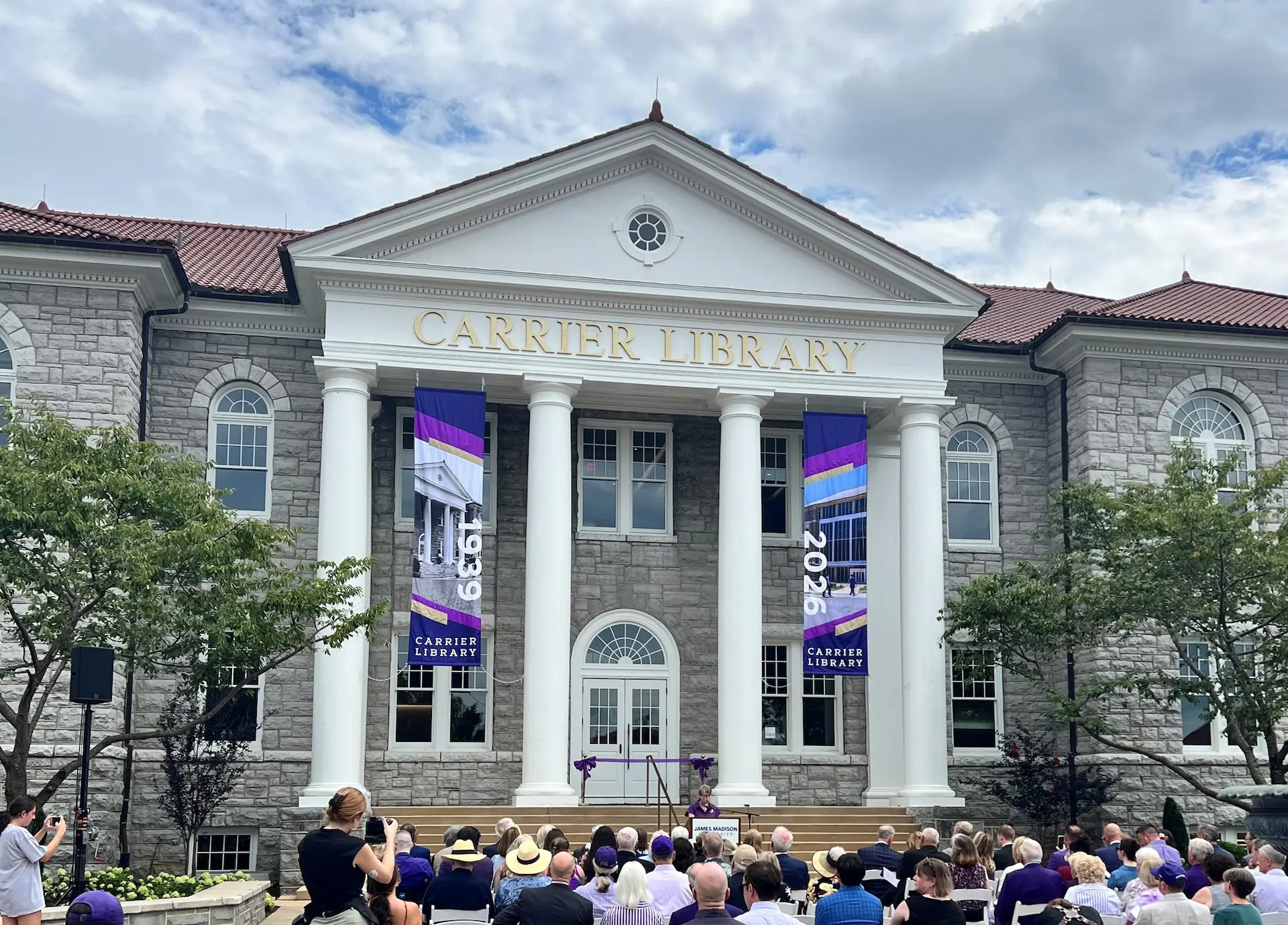
James Madison University (JMU) held a ribbon-cutting ceremony Sept. 10, 2026, marking the completion of a renovation and expansion of Carrier Library, designed by Moseley in collaboration with Robert A.M. Stern Architects (RAMSA). The project restores architectural details original to the building's 1939 construction while adding research, technology and gathering space requested by students, faculty, and library staff.
A Renovated Landmark Reopens
The ceremony followed the library's reopening to the public Aug. 3, 2026, after the building closed for renovation in 2023, having welcomed nearly one million visitors a year despite the aging facility's limitations. JMU's Carnegie classification as a high research doctoral institution, awarded by the American Council on Education, along with the university's improved standing in national rankings, prompted the decision to update and expand the library. Moseley and RAMSA worked alongside JMU stakeholders and library leadership to design a building that preserves the library's original character while adding space suited to a research university.
Connecting Decades of Architecture
The design unifies additions built across several decades with the original 1939 structure by opening a double-height atrium where structural stacks once stood, giving visitors long sightlines through the building.
"What was most exciting for us in the chance to design Carrier Library—to expand it, to renovate it—was to make real that notion of an intellectual crossroads and to make it a physical crossroads for our campus as well," said Bethany Nowviskie, dean of libraries. "A lot of care has gone into the design of the new building to encourage that flow of people and ideas."
"What was most exciting for us in the chance to design Carrier Library—to expand it, to renovate it—was to make real that notion of an intellectual crossroads and to make it a physical crossroads for our campus as well. A lot of care has gone into the design of the new building to encourage that flow of people and ideas." <p class="testimonial-name">Bethany Nowviskie, Dean of Libraries</p>
Contractors removed dropped ceilings to reveal original plaster column capitals and uncovered Bluestone quarried in the Shenandoah Valley, both restored and incorporated into the finished building. In the McCormack Historic Entrance, the design team restored the library's original 1939 staircase and returned the Joan of Arc statue, a campus fixture since 1917, to its original spot in the lobby.
The Stan and Rosemary Jones Wing
A 56,000-square-foot addition, the Stan and Rosemary Jones Wing extends the library toward downtown Harrisonburg and is clad in bluestone to match the original building. Its Grand Reading Room seats 236 people beneath windows overlooking the Shenandoah Valley, and a stair art installation, the McCormack Steps of the Shenandoah, uses 55 waterjet-cut metal panels to depict the region's rivers on the grand stair connecting three floors.
New Spaces for Collaboration and Research
Carrier Library includes 34 group study rooms and a 24-hour study space across its four floors, organized by sound level from collaborative spaces on the lower floors to quiet study above. Floor-to-ceiling windows in the double-height mezzanine let sunlight in and offer campus and mountain views.
“The amazing windows really brighten up this vibrant academic hub. It really invites students to come together, to collaborate, be creative, and to consult with one another as they focus on their academic studies,” said JMU President James C. Schmidt.
The building is also now home to the Furious Flower Poetry Center, the nation's first academic center dedicated to Black poetry, along with the Makery makerspace, the Thomas Family Anatomy Lab and two student art galleries.


.webp)





































.avif)