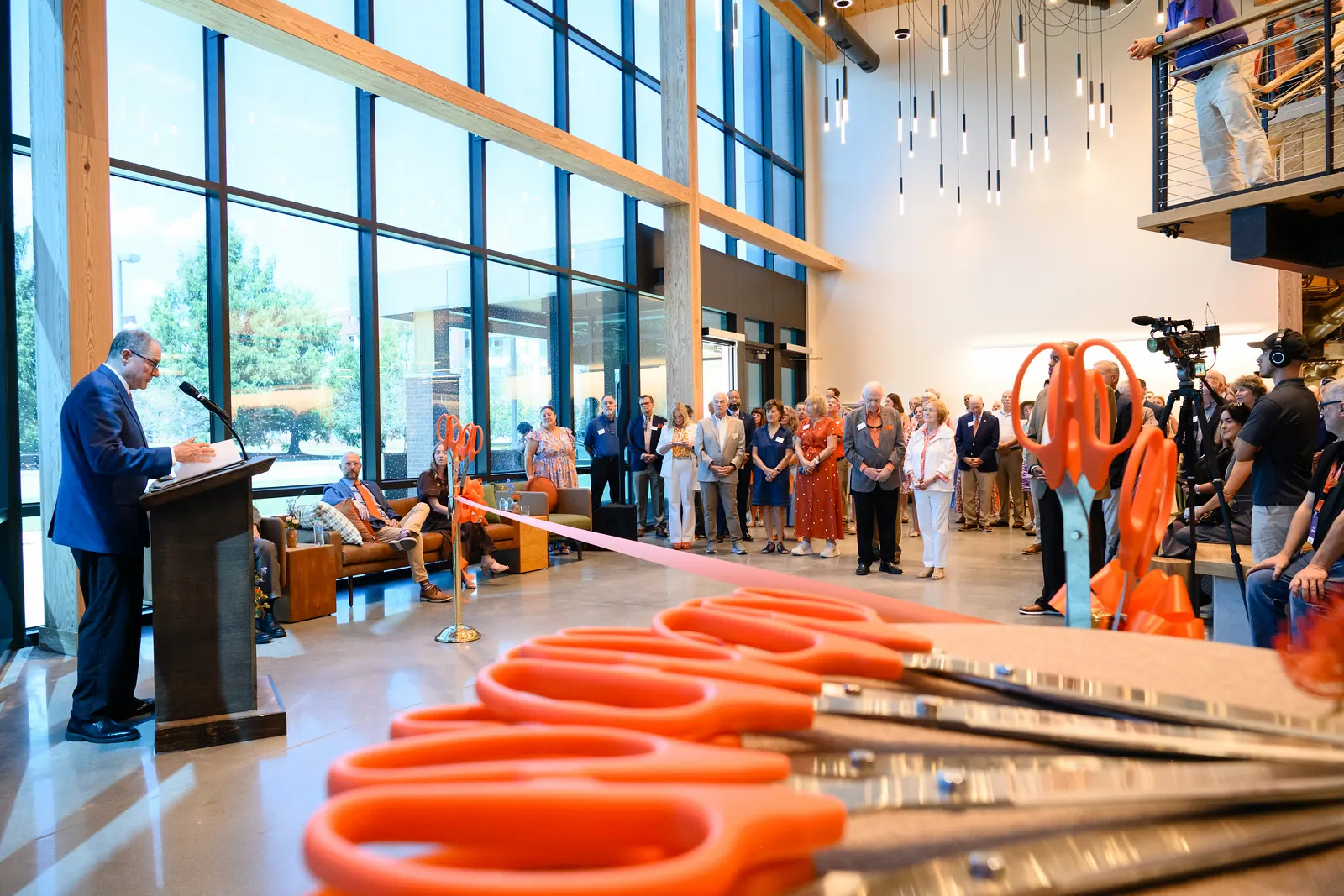
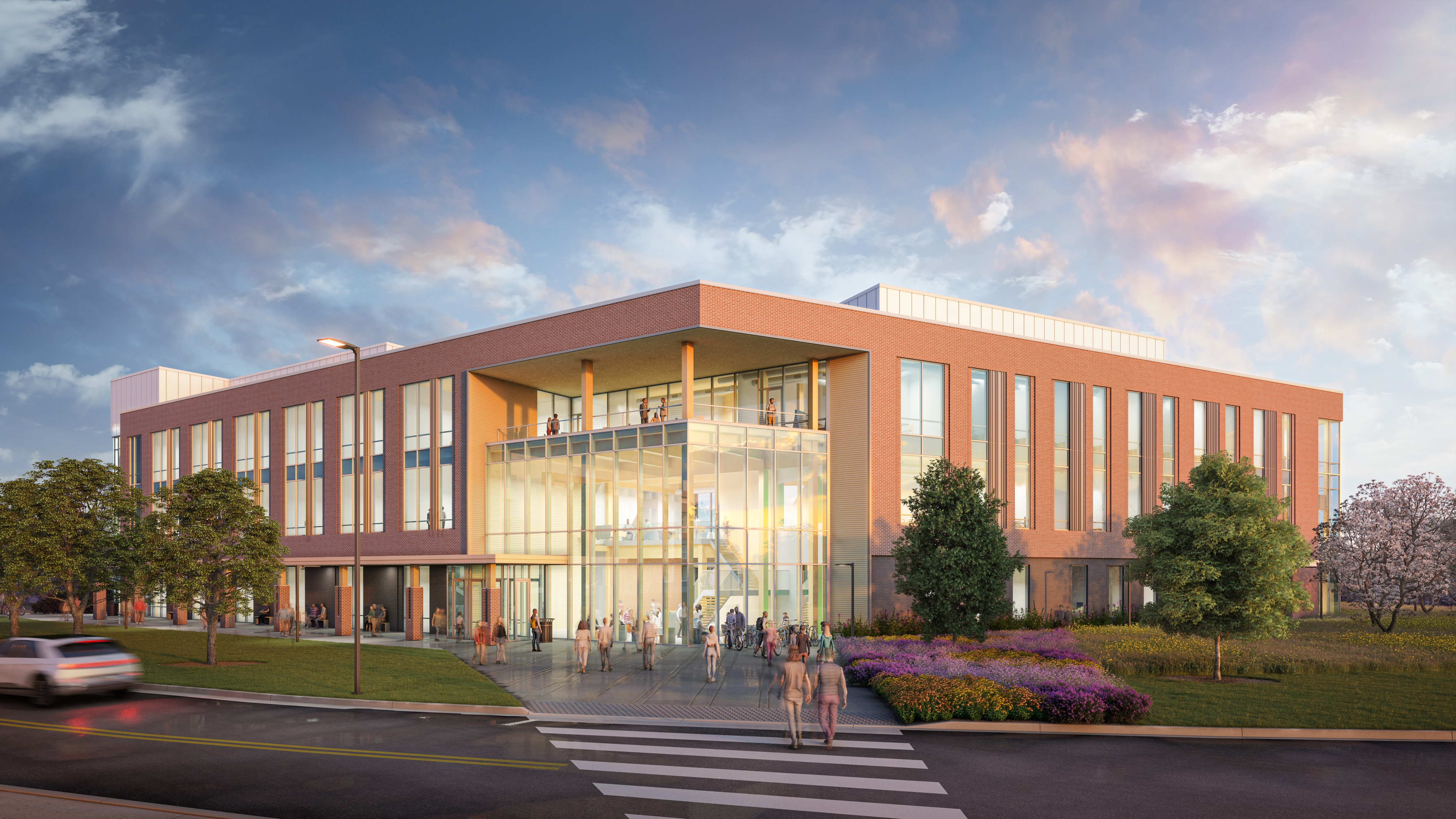
Clemson University marked the completion of its new Forestry and Environmental Conservation (FEC) Building on Sept. 11, 2026, with a ribbon-cutting ceremony. The 85,000-square-foot, four-story facility, designed by Moseley, replaces Lehotsky Hall as the home for the university's forestry and environmental conservation programs.
From Renovation to New Construction
The project began as a study to renovate Lehotsky Hall. University leaders determined that new construction would better serve the department's teaching and research needs, and Clemson selected a prominent gateway site at the southern edge of campus for the new building.
More than 50 stakeholders took part in the design process that followed, including faculty, staff, students, university facility planning representatives, and the Wood Utilization Institute, along with faculty from the architecture, engineering, and construction science programs.
Design Shaped by the Landscape
The building's three-wing layout forms a partially enclosed courtyard that buffers the space from a nearby campus road and opens views to the surrounding landscape. A 50-foot grade change across the site allowed designers to place a lower level for functions requiring vehicular access, and accessible paths wind through the property, connecting to Honeycutt Creek and to a campus-wide trail network. The site, a former parking lot, now includes a curated arboretum and a restored native forest that provides habitat for local fauna.
"From the earliest sketches, we treated the site as a teaching tool as valuable as the building itself. Every space was designed and placed to keep students connected to the landscape they are there to study," said Daniel Whitmire, design principal at Moseley.
Local Wood, Local Partnerships
One facade reflects Clemson's traditional brick architecture, while another features corrugated metal panels patterned after cross-sections of Southern Yellow Pine. Cross-laminated timber and glulam components make up the primary structure of the building, with cross-laminated panels accounting for 62,000 square feet of the facility. Norfolk Southern donated the wood, harvested from the Brosnan Forest, as part of its Climate-Smart Grown in SC project, and Clemson named a classroom laboratory in the building the Norfolk Southern Teaching Lab in recognition of the donation. Collum's Lumber, led by Clemson forest management alumnus Mitchell Scott, processed the wood locally, and SmartLam fabricated it into the structural components installed throughout the building. A separate Clemson research project applied blockchain technology to track the wood's path from forest to building. Local artisans shaped salvaged wood from campus into stair treads, balustrades, paneling, flooring, and custom shelving.
"Mass timber does not behave under load the same way that steel does, so every beam and connection had to be sized and detailed with those differences in mind. Keeping the wood exposed meant that every decision was on full display, which pushed our team to balance both the form and function of the structure," said Steven Cooke, structural engineer at Moseley.
Spaces for Teaching and Collaboration
Inside, a two-story lobby frames the courtyard and the wooded landscape beyond. Classrooms designed to merge into a 3,000-square-foot event venue join research laboratories and project rooms that support teaching and collaboration. Glazing throughout the building reduces glare and manages daylight, and interior color palettes of green and blue reflect the department's focus on forestry, wildlife, fisheries, and conservation. A rooftop terrace on the third level offers views across campus, and portions of the exposed wood structure remain visible from outside the building.
"We wanted a home for FEC that represented the character of the department and the future its graduates are helping to shape, and this building does that through its materials, its flexibility and its strong connection to the campus landscape." <p class="testimonial-name">Matthew Holt, Dean of Clemson's College of Agriculture, Forestry and Life Sciences</p>
Part of a Broader Shift Toward Mass Timber
The FEC Building arrives as mass timber construction expands across higher education and other sectors nationwide. WoodWorks, a nonprofit organization that tracks wood building projects in the United States, counted 2,833 multi-family, commercial, or institutional mass timber projects built or in progress as of June 2026. The FEC Building adds a higher education project to that count, giving the department a home built from the same wood products it studies and teaches.
The building also opens as demand for the department's graduates continues. The U.S. Bureau of Labor Statistics projects employment of conservation scientists and foresters to grow four percent from 2025 to 2035, with about 3,000 openings projected each year over that decade, a field the department prepares its students to enter.


.webp)

























.avif)